
From Maps to Machine Reasoning: Inside Esri’s Next-Gen GeoAI Framework
Discover how Esri’s ArcGIS integrates AI, agents, and spatial reasoning to move beyond maps and deliver real-time, explainable geospatial decisions.

Let’s start with a premise: Geospatial data is everywhere, but insight is rare.
Now imagine a system where AI doesn’t just analyze location data, but reasons with it, explains it, and even acts on it. That’s not theoretical anymore. That’s Esri's evolving GeoAI framework in motion—a strategic fusion of Artificial Intelligence with spatial infrastructure, now embedded deeply into ArcGIS.
The U.S. Department of Commerce is leaning into this. In partnership with Esri, they’re leveraging AI-powered spatial intelligence to modernize decision systems, enhance national security capabilities, and respond to complex global challenges in real time.
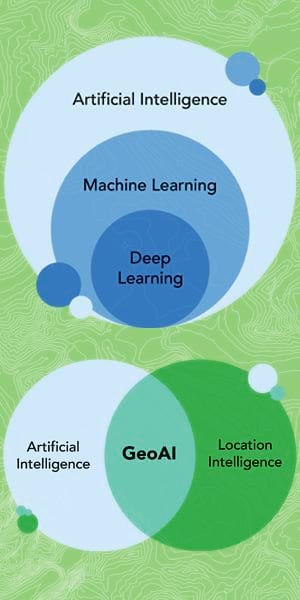
What makes GeoAI different?
GeoAI is not just about embedding AI tools inside a GIS platform. Esri’s approach treats AI as a spatial reasoning engine. This means rethinking everything—from data architecture to workflow logic to the very interface through which analysts interact with their data.
At its core, GeoAI operates across four pillars:
Data Collection + Fusion
GeoAI enables ingestion from diverse sources: IoT sensors, satellite streams, UAV imagery, social media feeds, and government databases.
Esri’s architecture supports seamless integration with centralized data lakes, real-time telemetry systems, and commercial datasets.
Tools like ArcGIS Data Interoperability and ArcGIS Velocity allow near-instantaneous preprocessing and enrichment of spatial and tabular data.
Smart Visualization & Mapping
Using ArcGIS API for JavaScript and Feature Layers, users can build dynamic, browser-based visualizations.
These interfaces support real-time querying, semantic filtering, and predictive overlays—visual cues powered by ML predictions.
With Indexed 3D Scene (I3S) standards and Scene Layer Packages (SLPK), users can explore multi-resolution, interactive 3D urban or terrain environments enriched with AI output.
Multi-Factor Analysis & Modeling
Esri integrates statistical models (OLS, GWR, EBK) and ML techniques (Random Trees, Support Vector Machines, Deep Learning) directly into ArcGIS Pro.
ArcGIS supports Python (ArcPy, ArcGIS API for Python) and R through the R-ArcGIS Bridge, letting analysts inject scikit-learn, TensorFlow, and Keras into spatial workflows.
Complex modeling workflows can be automated using ModelBuilder and ArcGIS Notebooks, ensuring reproducibility and performance scaling via batch processing or parallel compute environments.
Collaborative Dissemination
Dashboards, Experience Builder apps, and Hub sites allow organizations to share AI-powered insights with internal teams or the public.
Esri's Enterprise environment supports RESTful APIs and OAuth-secured sharing to ensure data governance, while providing real-time data subscriptions to partner agencies.
Through GeoAI, users can rapidly push out alerts, risk scores, and recommended actions based on location-contextualized ML outputs.
Agents, Not Just Algorithms
The real evolution lies in how Esri is implementing AI Agents. These agents are:
Autonomously operating units, powered by large language models (LLMs), GenAI, and spatial reasoning engines
Capable of memory recall, tool use, goal setting, and peer-to-peer communication with other agents
Configurable to specialize in domain-specific analysis—urban planning, logistics, climate risk, or public health
Esri is layering Object-Driven AI (ODAI) on top of Generative AI. While GenAI focuses on content generation and NLP tasks, ODAI adds interpretive logic, causal reasoning, and physics-based constraints.
For example:
GenAI might generate a textual summary of flood risks.
ODAI can simulate hydrological scenarios, recommend mitigative planning actions, and forecast infrastructure stress.
Together, these agents can:
Interpret new incoming spatial-temporal data
Identify anomalies or emergent patterns
Recommend and explain potential courses of action with confidence scoring
This is far beyond simple classification. It's spatial cognition at enterprise scale.
Why This Matters Now
In an age of exponential data growth, traditional GIS is insufficient. Static maps and delayed analysis are incompatible with the demands of climate change, pandemics, infrastructure resilience, and defense coordination.
Esri's GeoAI architecture brings AI to the operational layer:
Real-time object detection on drone imagery
Pattern-of-Life (PoL) analysis using social media heatmaps
Automated land use change detection from Sentinel-2 data
Prediction of public health outbreaks based on proximity and environmental variables
All of this is possible through:
Distributed cloud computing (ArcGIS Enterprise + Azure DSVM)
Open data standards (OGC, IHO, ISO integration)
Over 300 supported formats, minimizing vendor lock-in
GeoAI is not just a technical advantage. It’s a strategic differentiator.
Spatial Intelligence, Operationalized
GeoAI is being positioned as the digital nervous system of the U.S. Commerce Department’s data modernization.
ArcGIS Knowledge enhances link analysis and graph-based insights across mission-critical datasets. AI-infused spatial networks now:
Model supply chain resilience across geopolitical zones
Evaluate maritime traffic patterns and anomalies
Connect intelligence dots across structured and unstructured sources
With tools like Exploratory Regression and Causal Inference, analysts can now:
Understand why patterns occur
Simulate what if scenarios
Quantify the impact of decisions before they're made
GeoAI brings explainability, transparency, and actionability to the forefront of spatial analytics.
A Closing Thought
AI is only as good as the context it understands. And spatial context—where events happen, what surrounds them, how they evolve over time—is often the missing link.
Esri’s GeoAI strategy doesn’t just fill that gap. It reframes the entire value chain.
This is no longer about maps. This is about machine reasoning. This is about decision supremacy. This is about building the geospatial AI infrastructure for the decade ahead.